5.b: Understanding Model & Tool Choices (June 2026)
Choosing the right model for an AI coding task is one of the most impactful decisions you make on a daily basis. The model determines quality, speed, cost, and context capacity. In mid-2026, the two major provider families for coding agents are Anthropic's Claude models and OpenAI's GPT/o-series models.
The Claude Model Family (Anthropic)
Claude Code defaults to Opus 4.8 but offers a full model family accessible via configuration or the /fast toggle.
Claude Models for Coding (June 2026)
| Model | ID | Context | Strengths | Best For |
|---|---|---|---|---|
| Fable 5 | claude-fable-5 | 200K tokens | Latest and most capable; strongest on novel problems and creative solutions | Complex architecture, novel features, research-grade tasks |
| Opus 4.8 | claude-opus-4-8 | 200K tokens | Top-tier reasoning and instruction following; Claude Code default | Multi-file refactoring, complex bug fixing, code review |
| Sonnet 4.6 | claude-sonnet-4-6 | 200K tokens | Best balance of speed, quality, and cost | Daily coding tasks, routine refactoring, test generation |
| Haiku 4.5 | claude-haiku-4-5-20251001 | 200K tokens | Fastest and cheapest; still highly capable for straightforward tasks | High-volume operations, quick lookups, simple fixes |
Model Selection in Claude Code
# Default: uses Opus 4.8
claude

# Start with a specific model
claude --model claude-sonnet-4-6

# Toggle to Sonnet mid-session for speed
# (inside a Claude Code session)
/fast

# Toggle back to Opus for a complex task
/fast
Claude Model Selection Strategy
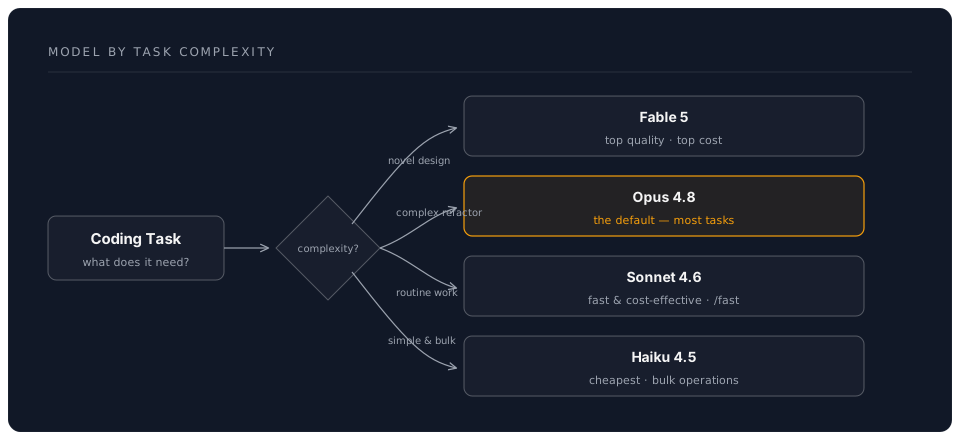
Practical guidance:
- Start a session with Opus 4.8 (the default) for any non-trivial task
- Switch to Sonnet 4.6 via
/fastwhen iterating on implementation details or generating tests - Use Haiku 4.5 for bulk operations (e.g., adding JSDoc comments to 50 functions)
- Reserve Fable 5 for tasks where you want the absolute best output quality
Pricing
Model pricing changes frequently. Check console.anthropic.com for current per-token rates. The general ordering from most to least expensive is: Fable 5 > Opus 4.8 > Sonnet 4.6 > Haiku 4.5.
Claude Code displays session costs via the /cost command.
The OpenAI Model Family
OpenAI Codex CLI supports multiple models via the --model flag.
OpenAI Models for Coding (June 2026)
| Model | Strengths | Best For |
|---|---|---|
| o3 | Deep reasoning, chain-of-thought, strongest on complex logic | Algorithms, system design, debugging subtle issues |
| GPT-4o | Fast, capable, multi-modal (text + image) | General coding, UI implementation from screenshots |
| o4-mini | Fast reasoning at lower cost | Interactive CLI use, quick iterations |
| codex-mini-latest | Optimised for Codex CLI specifically | Default for Codex CLI terminal tasks |
| codex-1 | Fine-tuned for software engineering (o3 architecture) | Codex Cloud Agent (within ChatGPT) |
Model Selection in Codex CLI
# Default model (codex-mini-latest)
codex "Add input validation"

# Use GPT-4o for a more complex task
codex --model gpt-4o "Architect a caching layer for the API"

# Use o3 for a hard algorithmic problem
codex --model o3 "Optimise the pathfinding algorithm for large graphs"

# Use o4-mini for quick, cheap tasks
codex --model o4-mini "Format all files with Prettier"
OpenAI Pricing
Check platform.openai.com for current per-token rates. The general ordering from most to least expensive is: o3 > GPT-4o > codex-1 > o4-mini > codex-mini.
Open-Weight and Local Models
For privacy-sensitive work or offline use, both Codex CLI and Aider support local models via Ollama or other OpenAI-compatible APIs.
| Model | Provider | Strengths | Limitations |
|---|---|---|---|
| DeepSeek Coder V3 | DeepSeek (or local) | Strong coding, open weights | Requires significant GPU for local |
| CodeLlama | Meta (via Ollama) | Good for common languages | Smaller context, less capable than frontier |
| Mixtral | Mistral (via Ollama) | Fast, decent coding | Not as strong as GPT-4o/Claude for complex tasks |
# Using a local model with Codex CLI
codex --provider ollama --model deepseek-coder-v3 "Explain this function"

# Using a local model with Aider
aider --model ollama/deepseek-coder-v3
Local models are best for:
- Air-gapped environments
- Reducing API costs for simple tasks
- Experimentation and learning
- Privacy-critical codebases
They are generally not recommended for complex multi-file refactoring where frontier models (Opus 4.8, o3) substantially outperform.
Cross-Provider Comparison
Head-to-Head: Coding Task Performance
| Task Type | Best Claude Model | Best OpenAI Model | Notes |
|---|---|---|---|
| Multi-file refactoring | Opus 4.8 | o3 | Both excellent; Claude Code's tooling gives it an edge |
| Quick bug fix | Sonnet 4.6 | GPT-4o | Fast, capable, good value |
| Test generation | Sonnet 4.6 | codex-mini | High volume, lower cost matters |
| Algorithm design | Fable 5 | o3 | Both strong at deep reasoning |
| Code review | Opus 4.8 | o3 | Long context helps (Claude's 200K advantage) |
| Documentation | Sonnet 4.6 | GPT-4o | Both produce good docs |
| Simple scripting | Haiku 4.5 | o4-mini | Cheapest options, still capable |
Context Window Comparison
| Model | Context Window |
|---|---|
| Claude Fable 5 | 200K tokens |
| Claude Opus 4.8 | 200K tokens |
| Claude Sonnet 4.6 | 200K tokens |
| Claude Haiku 4.5 | 200K tokens |
| GPT-4o | 128K tokens |
| o3 | 128K-200K tokens |
| codex-mini | 128K tokens |
The 200K context window across all Claude models is a significant advantage for large codebases where the agent needs to consider many files simultaneously.
Practical Model Selection Framework
Decision Matrix
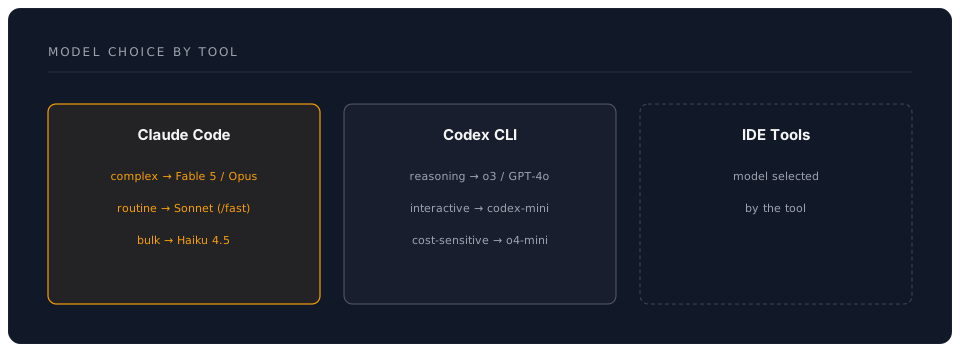
Cost Optimisation Tips
- Start expensive, then downgrade: Begin a task with Opus or o3 to get the architecture right, then switch to Sonnet/o4-mini for iteration
- Use
/fastmode liberally in Claude Code: Sonnet 4.6 handles the vast majority of coding tasks well - Monitor costs: Use Claude Code's
/costcommand and OpenAI's usage dashboard - Batch simple tasks: Accumulate small fixes and run them as a batch with a cheaper model
- Match model to task, not to habit: Do not use o3 for formatting code; do not use Haiku for system design
The "Best" Model is Context-Dependent
There is no single best model. The optimal choice depends on:
- Task complexity — How much reasoning is needed?
- Speed requirements — Is this interactive or batch?
- Cost sensitivity — How many tokens will this consume?
- Context needs — How much code must the model consider?
- Provider preference — Which ecosystem are you invested in?
Model capabilities evolve rapidly. What holds in June 2026 may shift by September 2026. Re-evaluate your default model choice periodically and stay current with provider announcements.