Introduction to AI Agents
The Age of Autonomous AI (2025-2026)
We are in the midst of a fundamental shift in how AI systems operate. Rather than simple question-answer interactions, modern AI agents can reason, plan, use tools, and execute complex tasks autonomously -- and in 2026, the tooling to build and deploy them has matured from experimental to production-grade.
What Makes 2025-2026 Different?
The Agent Revolution
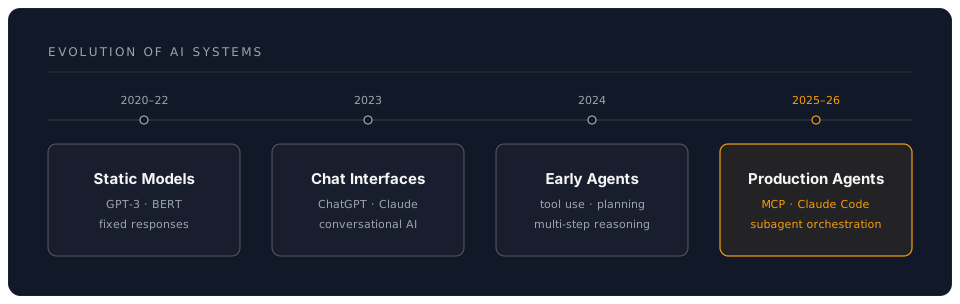
Traditional AI (Pre-2024):
- User asks question, AI responds
- No tool access
- No memory between sessions
- No ability to break down complex tasks
AI Agents (2025-2026):
- AI receives goal, plans steps, executes autonomously
- Uses external tools via standardised protocols (MCP)
- Maintains conversation and task memory across sessions
- Decomposes complex problems into subtasks with subagents
- Self-corrects when errors occur
- Operates as full coding agents (Claude Code, OpenAI Codex CLI, Aider)
Real-World Agent Applications
| Domain | Agent Type | Example Tools |
|---|---|---|
| Software Development | Coding Agent | Claude Code, Codex CLI, Cursor, Aider |
| Research | Research Agent | Deep research workflows, web search MCP servers |
| Data Analysis | Analytics Agent | Database MCP servers, code execution sandboxes |
| DevOps | Operations Agent | GitHub MCP, filesystem tools, deployment pipelines |
| Content & Docs | Writing Agent | Multi-step workflows with review and refinement |
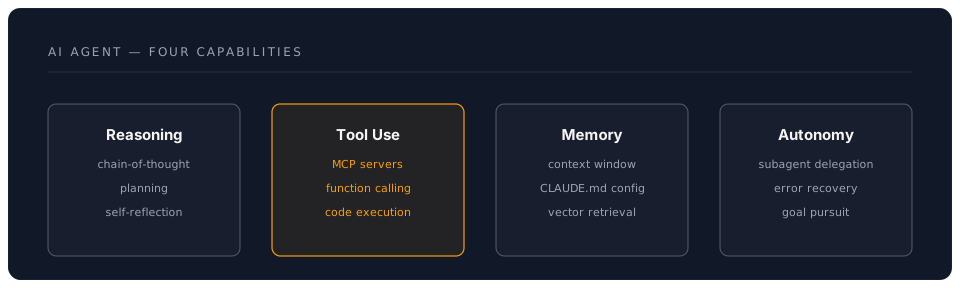
Key Agent Capabilities
The Agent Architecture Stack
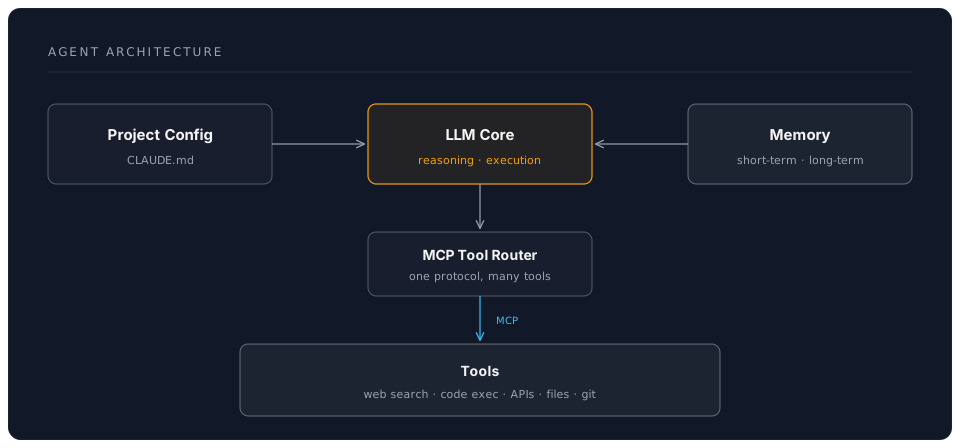
Modern AI agents combine multiple components:
Why Agents Matter Now
1. Foundation Models Are Production-Ready
Models like Claude Fable 5, Opus 4.8, Sonnet 4.6, GPT-4o, and o3 have:
- Strong multi-step reasoning capabilities
- Reliable structured tool use
- Extended context windows (200K+ tokens)
- Significantly reduced hallucination rates
- Native support for agent workflows
2. The MCP Standard Has Unified Tool Integration
The Model Context Protocol (MCP) has become the standard for connecting AI agents to tools:
- One protocol, any tool: filesystem, databases, GitHub, Slack, search, and hundreds more
- Any model, any client: Claude Code, Cursor, Windsurf, and other clients all speak MCP
- Community ecosystem: hundreds of open-source MCP servers available
3. Production Agent Tools Are Mature
The ecosystem has moved well beyond frameworks:
- Claude Code: Terminal-based coding agent with subagents, workflows, hooks, and CLAUDE.md configuration
- OpenAI Codex CLI: Open-source terminal agent for code tasks
- Anthropic Agent SDK: Python/TypeScript SDKs for building custom agents
- Cursor / Windsurf: IDE-integrated agents with MCP support
- Aider: Open-source terminal pair-programming agent
4. Production Use Cases Are Proven
Organisations are deploying agents at scale:
- Claude Code: Full software development workflows with subagent delegation
- GitHub Copilot Workspace: Autonomous coding from issues to PRs
- Cursor AI: IDE-native agent for refactoring and feature development
- Custom agents: Built with the Anthropic Agent SDK for domain-specific tasks
The ReAct Pattern: Reasoning + Acting
The foundational pattern that powers modern agents:
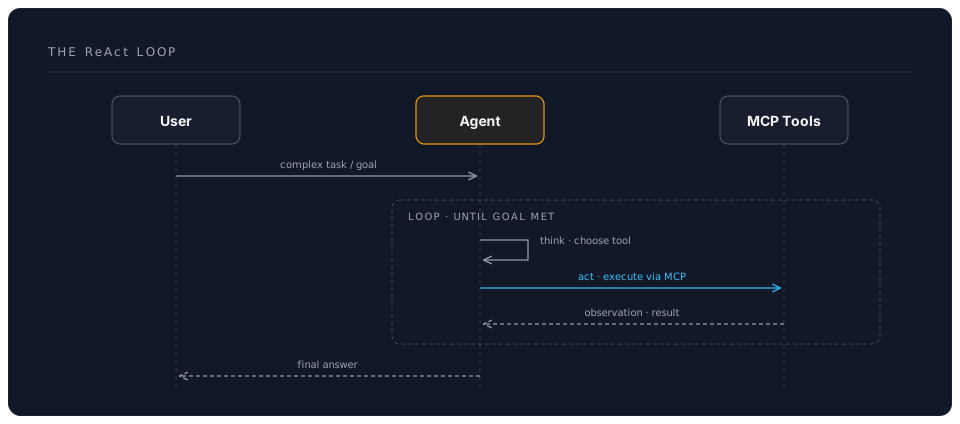
Example: "Find the latest AI research on agents and summarise"
Thought: I need to search for recent AI agent research papers
Action: web_search("AI agents research 2026")
Observation: Found 5 recent papers from arXiv

Thought: I should read the abstracts of these papers
Action: read_url("https://arxiv.org/abs/2601.xxxxx")
Observation: Paper discusses multi-agent coordination...

Thought: Now I can synthesise findings
Action: create_summary([paper1, paper2, paper3])
Observation: Summary created

Thought: I have enough information to answer
Final Answer: Recent AI agent research focuses on...
What You'll Build Today
By the end of this workshop, you will create:
- Basic Agent: Tool-using agent with the Claude API and MCP
- Claude Code Workflow: Multi-step coding agent using subagents
- Research Agent: Web-searching autonomous agent with citations
- Multi-Tool Agent: Agent combining multiple MCP servers
Technologies Covered
- Claude API: Anthropic's tool use implementation (Sonnet 4.6, Opus 4.8)
- Claude Code: Terminal agent with subagents and workflows
- MCP Servers: Standardised tool integration protocol
- Anthropic Agent SDK: Building custom agents in Python and TypeScript
- Aider / Codex CLI: Open-source terminal agents for comparison
The Agent Mindset
Building agents requires thinking differently:
| Traditional Programming | Agent Programming |
|---|---|
| Explicit control flow | Goal-directed behaviour |
| Deterministic execution | Probabilistic reasoning |
| Error handling with try/catch | Self-correction loops |
| Fixed functionality | Dynamic tool selection via MCP |
| Step-by-step instructions | High-level objectives in CLAUDE.md |
Looking Ahead
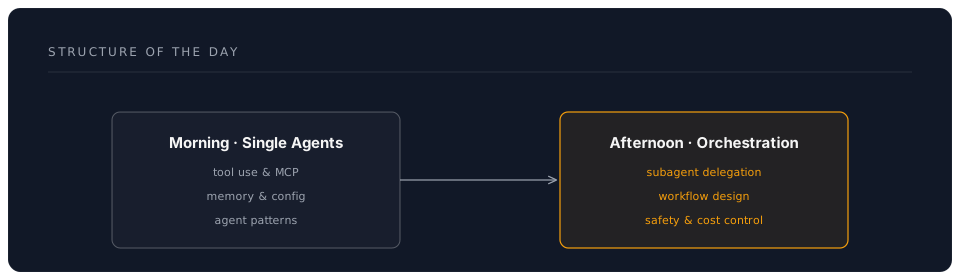
This morning focuses on individual agents. This afternoon, we will explore:
- Multi-agent orchestration patterns
- Claude Code subagent workflows
- Safety, cost control, and guardrails
- Production deployment patterns