Chapter 1: Core Concepts - Understanding AI APIs in 2026
The Modern AI API Landscape
The AI API ecosystem has matured dramatically. Understanding these fundamentals empowers you to harness cutting-edge models with precision and control.
💡 Tip: Think of APIs as your direct line to the world's most powerful AI models—no intermediaries, no limitations.
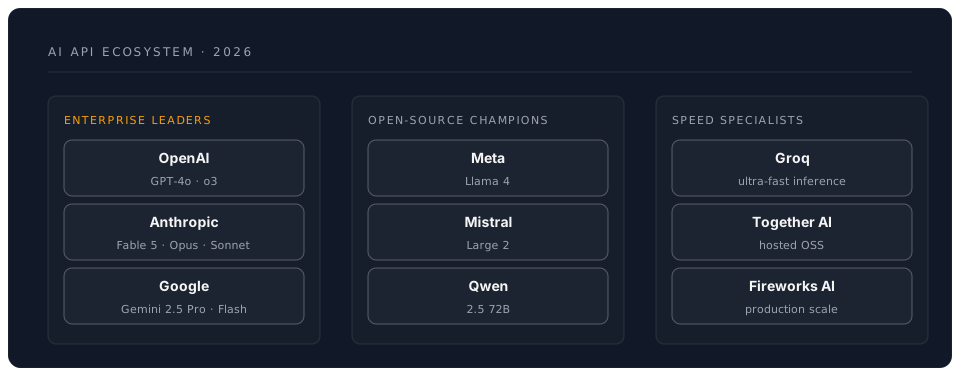
What Is an API? (The Simple Truth)
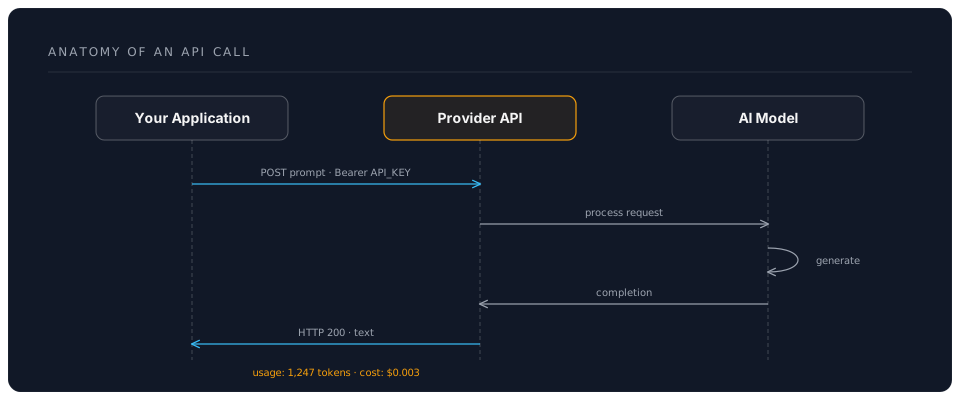
The Restaurant Analogy 🍽️
An API is like ordering at a restaurant:
- You (Client): Place your order (send a request)
- Waiter (API): Takes order, brings food (handles communication)
- Kitchen (AI Model): Prepares your meal (processes your request)
You don't need to know how the kitchen works—just order what you want and receive results.
Technical Definition (For the Curious)
An API (Application Programming Interface) allows software to communicate. For AI services:
⚠️ Warning: Never share your API keys publicly—treat them like passwords!
REST APIs: The Universal Language
What is REST?
REST (Representational State Transfer) is how web services talk:
- Uses HTTP methods:
GET,POST,PUT,DELETE - Stateless: Each request is independent
- Returns structured data (JSON format)
Anatomy of an AI API Request
curl https://api.openai.com/v1/chat/completions \
  -H "Content-Type: application/json" \
  -H "Authorization: Bearer YOUR_API_KEY" \
  -d '{
    "model": "gpt-4o",
    "messages": [
      {
        "role": "system",
        "content": "You are a helpful AI assistant."
      },
      {
        "role": "user",
        "content": "Explain quantum computing in simple terms"
      }
    ],
    "temperature": 0.7,
    "max_tokens": 500
  }'
Breaking it down:
- Endpoint: Where to send the request
- Headers: Authentication and content type
- Body: Your configuration and prompt
- Response: JSON with AI-generated text
📝 Note: Most developers use SDKs (libraries) that handle this complexity for you.
Authentication: API Keys Explained
What is an API Key?
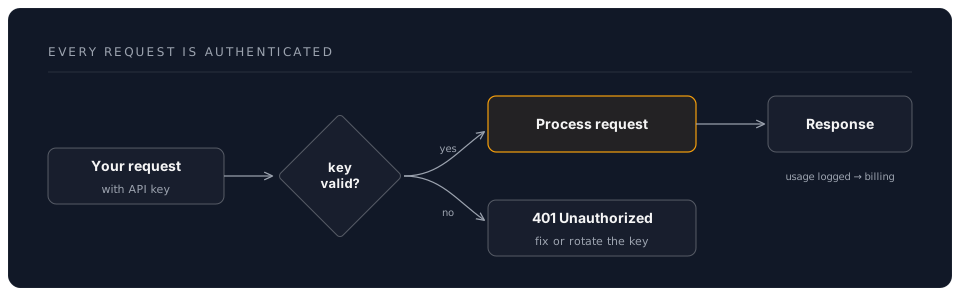
Your API key is your unique identifier—like a password that:
- Authenticates your requests
- Tracks your usage
- Enables billing
- Sets rate limits
API Key Security Best Practices (2026 Edition)
DO:
✅ Store keys in environment variables (.env files)
✅ Use secrets managers (AWS Secrets Manager, 1Password)
✅ Rotate keys every 90 days
✅ Set spending limits on all accounts
✅ Enable MFA on provider accounts
✅ Use separate keys for dev/prod environments
DON'T: ❌ Hardcode keys in source code ❌ Commit keys to Git repositories ❌ Share keys in Slack/Discord/email ❌ Use the same key across all projects ❌ Skip setting up budget alerts
Example: Secure Key Management
# ❌ WRONG - Never do this!
api_key = "sk-proj-abc123xyz..."

# ✅ CORRECT - Use environment variables
import os
from dotenv import load_dotenv

load_dotenv()
api_key = os.getenv("OPENAI_API_KEY")

if not api_key:
    raise ValueError("Missing OPENAI_API_KEY environment variable")
// ✅ TypeScript/Node.js example
import * as dotenv from 'dotenv';
dotenv.config();

const apiKey = process.env.OPENAI_API_KEY;
if (!apiKey) {
  throw new Error('Missing OPENAI_API_KEY');
}
# .env file (NEVER commit this!)
OPENAI_API_KEY=sk-proj-abc123...
ANTHROPIC_API_KEY=sk-ant-api03-xyz...
GEMINI_API_KEY=AIzaSy...
Token Economics: Understanding Costs
What Are Tokens? 🪙
Tokens are pieces of text. Think of them as:
- ~4 characters per token
- ~0.75 words per token
- Both input AND output count
Example:
"Hello, how are you today?" = 6 tokens
"I am doing great, thanks for asking!" = 8 tokens
Total conversation cost = 14 tokens
💡 Tip: Use OpenAI's tokenizer to see exact token counts.
2026 Pricing Comparison (USD per 1M tokens)
Pricing changes frequently. The table below gives a rough sense of relative costs — always check the provider's own pricing page for current rates.
| Provider | Model | Input | Output | Context | Best For |
|---|---|---|---|---|---|
| OpenAI | GPT-4o | ~$2.50 | ~$10.00 | 128K | General purpose |
| GPT-4o-mini | ~$0.15 | ~$0.60 | 128K | High volume | |
| o3 | Check platform.openai.com | 200K | Complex reasoning | ||
| Anthropic | Fable 5 | Check console.anthropic.com | 200K | Latest & most capable | |
| Opus 4.8 | Check console | 200K | Top-tier reasoning | ||
| Sonnet 4.6 | ~$3.00 | ~$15.00 | 200K | Best value premium | |
| Haiku 4.5 | ~$0.25 | ~$1.25 | 200K | Speed champion | |
| Gemini 2.5 Flash | Check aistudio.google.dev | 1M | Massive context, cheap | ||
| Gemini 2.5 Pro | Check console | 2M | Entire codebases | ||
| Groq | Llama 4 | Check console.groq.com | 128K | Fast & free tier |
📝 Note: Prices as of mid-2026. Models and pricing evolve rapidly — always check the provider console for current rates before budgeting.
Real-World Cost Thinking
The key principle: match the model to the task. You do not need the most expensive model for every job.
Scenario 1: Blog Article Generation
Task: Generate 1,500-word article
Input: ~500 tokens (prompt + outline)
Output: ~2,000 tokens (article)

A mid-tier model (GPT-4o, Sonnet 4.6): pennies per article
A budget model (Gemini Flash, Haiku 4.5): fractions of a penny

For 100 articles/month, expect under £5 with mid-tier models.
Scenario 2: Entire Codebase Analysis
Task: Review 50,000 tokens of code
Input: 50,000 tokens
Output: 3,000 tokens (review)

Gemini 2.5 Pro (2M context) handles this in a single pass.
Claude Sonnet 4.6 (200K) is excellent for detailed code review.

For 50 reviews/month, expect under £10 with either approach.
Scenario 3: Complex Reasoning Task
Task: Strategic business analysis
Input: 1,000 tokens (data)
Output: 5,000 tokens (analysis)

Premium models (Fable 5, Opus 4.8, o3) cost more but
justify it for tasks where reasoning quality matters.

⚠️ Reserve premium models for complex tasks — the difference is real!
Cost Optimization Strategies
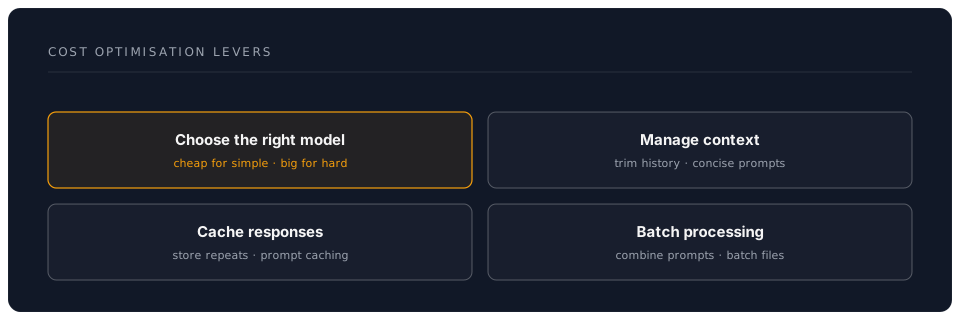
💡 Tip: Start with cheaper models, upgrade only when needed. Most tasks don't require Fable 5 or Claude Opus!
Rate Limits: Staying Within Bounds
What Are Rate Limits?
Providers limit how fast you can make requests:
- RPM: Requests Per Minute
- TPM: Tokens Per Minute
- TPD: Tokens Per Day
2026 Rate Limits (Typical Free/Tier 1)
Rate limits change as providers adjust tiers. Check each provider's documentation for the latest figures. Typical patterns:
| Provider | Free Tier | Paid Tier | Notes |
|---|---|---|---|
| OpenAI | Low RPM (~3-5) | Scales with spend | Tiers unlock at $5, $50, $100+ spend |
| Anthropic | Low RPM (~5) | Scales with deposit | Build tier at $5+, Scale by approval |
| Generous free tier | High throughput | Free tier includes 1.5M+ tokens/day | |
| Groq | Free with limits | Pay-as-you-go | Ultra-fast but lower daily caps |
⚠️ Warning: Rate limits reset based on time windows. Plan batch operations accordingly!
Handling Rate Limit Errors (Best Practices)
import time
from openai import OpenAI, RateLimitError
from tenacity import retry, stop_after_attempt, wait_exponential

client = OpenAI()

@retry(
    stop=stop_after_attempt(3),
    wait=wait_exponential(multiplier=1, min=2, max=10)
)
def make_api_call(prompt: str):
    """Makes API call with automatic retry and exponential backoff."""
    try:
        response = client.chat.completions.create(
            model="gpt-4o",
            messages=[{"role": "user", "content": prompt}],
            timeout=30  # Prevent hanging
        )
        return response
    except RateLimitError as e:
        print(f"⚠️ Rate limited: {e}. Retrying with backoff...")
        raise  # Let tenacity handle the retry
// TypeScript with exponential backoff
import OpenAI from 'openai';

const client = new OpenAI();

async function callWithRetry(
  prompt: string,
  maxRetries = 3
): Promise<string> {
  for (let attempt = 0; attempt < maxRetries; attempt++) {
    try {
      const response = await client.chat.completions.create({
        model: 'gpt-4o',
        messages: [{ role: 'user', content: prompt }],
      });
      return response.choices[0].message.content;
    } catch (error: any) {
      if (error.status === 429 && attempt < maxRetries - 1) {
        const waitTime = Math.pow(2, attempt) * 1000;
        console.log(`⏳ Rate limited. Waiting ${waitTime}ms...`);
        await new Promise(resolve => setTimeout(resolve, waitTime));
      } else {
        throw error;
      }
    }
  }
  throw new Error('Max retries exceeded');
}
Context Windows: Memory Capacity
What is a Context Window?
The maximum text an AI can "remember" in one conversation:
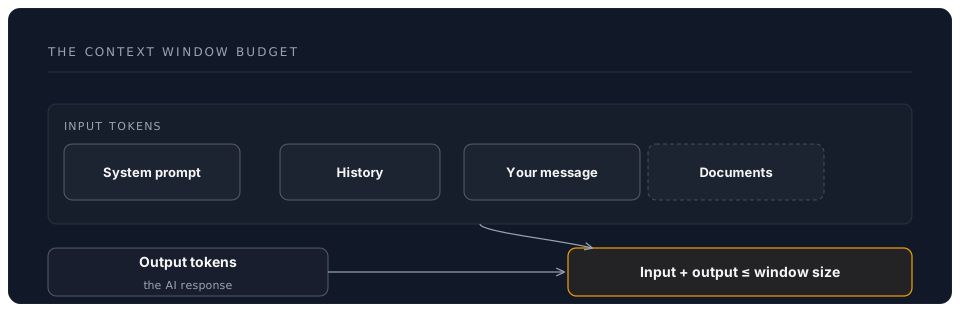
2026 Context Window Comparison
| Model | Context Window | ~Pages | Best Use Case |
|---|---|---|---|
| GPT-4o | 128K | ~300 | Standard documents |
| o3 | 200K | ~500 | Complex reasoning |
| Claude Fable 5 | 200K | ~500 | Latest & most capable |
| Claude Opus 4.8 | 200K | ~500 | Top-tier reasoning |
| Claude Sonnet 4.6 | 200K | ~500 | Best value large context |
| Claude Haiku 4.5 | 200K | ~500 | Speed + large files |
| Gemini 2.5 Flash | 1M | ~2,500 | Large documents |
| Gemini 2.5 Pro | 2M | ~5,000 | Entire codebases! |
| Llama 4 | 128K+ | ~300+ | Open source |
🎯 Exercise: Need to analyse a 1,000-page manual? Gemini 2.5 Pro can read it all at once!
Managing Long Conversations
from anthropic import Anthropic

class ConversationManager:
    """Manages conversation history with context window limits."""

    def __init__(self, max_tokens=100_000):
        self.max_tokens = max_tokens
        self.messages = []
        self.client = Anthropic()

    def add_message(self, role: str, content: str):
        """Add message and trim if needed."""
        self.messages.append({"role": role, "content": content})
        self._trim_if_needed()

    def _estimate_tokens(self, text: str) -> int:
        """Rough estimate: 1 token ≈ 0.75 words"""
        return int(len(text.split()) * 1.3)

    def _trim_if_needed(self):
        """Keep system message + recent context only."""
        total = sum(self._estimate_tokens(m["content"])
                   for m in self.messages)

        while total > self.max_tokens and len(self.messages) > 2:
            # Always keep system message (index 0)
            self.messages.pop(1)
            total = sum(self._estimate_tokens(m["content"])
                       for m in self.messages)

    def get_response(self, user_message: str) -> str:
        """Send message and get AI response."""
        self.add_message("user", user_message)

        response = self.client.messages.create(
            model="claude-sonnet-4-6",
            max_tokens=4096,
            messages=self.messages
        )

        ai_message = response.content[0].text
        self.add_message("assistant", ai_message)
        return ai_message
Model Selection: The Decision Matrix
Choosing the Right Model
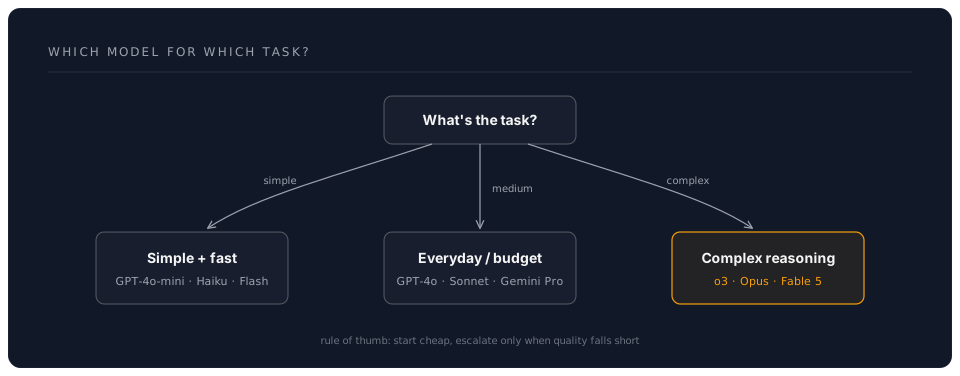
Model Strengths (2026 Edition)
| Model | Best For | Strengths | Watch Out For |
|---|---|---|---|
| GPT-4o | Balanced tasks | Reliable, fast, good at everything | Not specialised |
| GPT-4o-mini | High volume | Much cheaper, very fast | Less creative |
| o3 | Reasoning | Top-tier problem-solving, maths | Slower, pricier |
| Claude Fable 5 | Latest & best | Anthropic's most capable model | Premium pricing |
| Claude Opus 4.8 | Premium reasoning | Top-tier analysis and code | Expensive output |
| Claude Sonnet 4.6 | Coding/writing | Excellent code, natural prose, best balance | Mid-tier cost |
| Claude Haiku 4.5 | Speed + quality | Fastest premium model | Not for complex tasks |
| Gemini 2.5 Flash | Large docs | 1M context, very cheap | Check latest capabilities |
| Gemini 2.5 Pro | Massive context | 2M window, code analysis | Higher cost than Flash |
| Llama 4 | Open source | Free (via Groq), flexible | Needs more prompting |
Real-World Selection Examples
Writing a blog post? → Start with Claude Sonnet 4.6 (best prose) → Edit with GPT-4o-mini (cheap proofreading)
Analysing a large codebase? → Use Gemini 2.5 Pro (2M context window) → Get detailed review from Claude Sonnet 4.6
Complex maths problem? → o3 or Claude Opus 4.8 (specialised reasoning)
Quick customer support responses? → GPT-4o-mini or Haiku 4.5 (fast + cheap)
Creative storytelling? → Claude Fable 5 or Sonnet 4.6 (most natural)
Key Parameters Explained
Temperature (0.0 - 2.0)
Controls randomness:
# Deterministic, factual (0.0-0.3)
response = client.chat.completions.create(
    model="gpt-4o",
    temperature=0.2,  # Consistent answers
    messages=[{"role": "user", "content": "What is 2+2?"}]
)

# Balanced creativity (0.7-0.9)
response = client.chat.completions.create(
    model="gpt-4o",
    temperature=0.8,  # More creative
    messages=[{"role": "user", "content": "Write a poem about AI"}]
)

# Wild creativity (1.5-2.0)
response = client.chat.completions.create(
    model="gpt-4o",
    temperature=1.8,  # Very unpredictable!
    messages=[{"role": "user", "content": "Invent a new language"}]
)
Max Tokens
Limits response length:
# Short summary
response = client.chat.completions.create(
    model="gpt-4o",
    max_tokens=150,  # ~100 words
    messages=[{"role": "user", "content": "Summarize quantum computing"}]
)

# Detailed explanation
response = client.chat.completions.create(
    model="gpt-4o",
    max_tokens=2000,  # ~1,500 words
    messages=[{"role": "user", "content": "Explain quantum computing in detail"}]
)
Streaming Responses
Show text as it's generated:
from openai import OpenAI

client = OpenAI()

print("AI: ", end="", flush=True)
for chunk in client.chat.completions.create(
    model="gpt-4o",
    messages=[{"role": "user", "content": "Write a haiku"}],
    stream=True
):
    if chunk.choices[0].delta.content:
        print(chunk.choices[0].delta.content, end="", flush=True)
print()  # New line at end
Key Takeaways
✅ APIs provide direct access to AI models—no web interface needed ✅ API keys authenticate you—protect them like passwords ✅ Tokens = cost—input and output both count ✅ Rate limits exist—implement exponential backoff ✅ Context windows vary—choose model based on document size ✅ Different models excel at different tasks—select strategically ✅ Parameters control behaviour—temperature, max_tokens, streaming ✅ 2026 brings incredible value—Gemini 2.5 Flash, Haiku 4.5, and fierce competition across providers
Next: Chapter 2: Hands-On - Setting Up Your Multi-Model Command Centre