
16 Years of Deep Tech Research
The Octave laboratory (2007-2023) produced world-first collaborative immersive systems worth over £8M in research value. That research heritage now forms the foundation of our Applied Innovation Lab, commercialising deep tech for real-world impact.
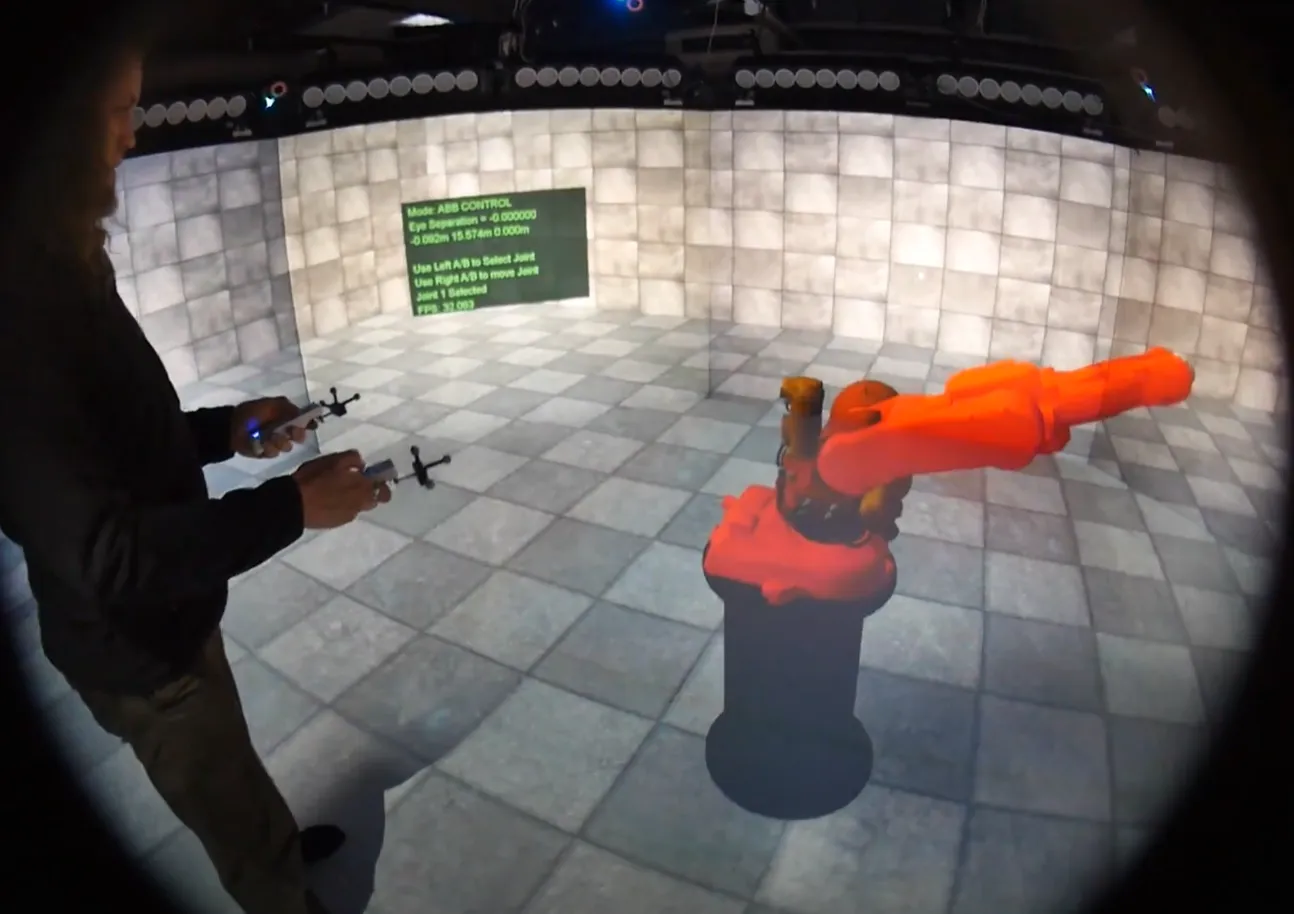
Multi-Viewpoint Immersive AI Research Platform
Core Innovation
Collaborative Immersion
Multiple specialists work together in a single immersive space with individual stereoscopic viewpoints, a world first in collaborative VR.
AI-Assisted Telepresence
Remote collaborators are brought into the space with full body presence and spatial audio. AI observes all communication channels in real-time.
Wave Field Synthesis
Spatial audio and volumetric telepresence enable natural, trust-based interaction, critical for multi-disciplinary problem solving.
Flow State Advantage
Focused Data Presentation
Each expert sees only their relevant data: no overload, no context switching. Domain-specific views reduce cognitive load.
Natural Interaction
Spatial interaction and communication are preserved. Professionals reach peak performance rapidly because the technology gets out of the way.
AI Learns from the Best
AI captures what each expert sees, says, and does, building a multi-viewpoint knowledge graph richer than any single perspective. It learns from the best, not the confused.
Real-World Impact
Nuclear Decommissioning Case Study
Planning time reduced from 8 hours to 2 hours
With improved safety outcomes and reduced specialist fatigue
AI learned and propagated emergent protocols (including 3D gesture languages and risk communication systems) across teams and domains. This is the kind of applied innovation that our lab now commercialises for industry.
Technical Summary
| Component | Enables | AI Learns |
|---|---|---|
| Multi-viewpoint stereo | Individual flow states | Peak performance patterns |
| Wave Field Synthesis | Natural communication | Consensus acoustics |
| Neural telepresence | Distributed expertise | Full team dynamics |
| Gesture/gaze tracking | Spatial grounding | Embodied concepts |
| Domain-specific views | Cognitive load reduction | Efficient narratives |
From Research to Applied Innovation
2007-2015
Foundation research: multi-viewpoint stereo, wave field synthesis, gesture tracking. Building the core immersive collaboration platform.
2015-2019
AI observation and mediation. Nuclear decommissioning case study. Team ontology emergence mapping.
2019-2023
Expansion to larger teams and new domains. Standards development. Commercialisation groundwork.
2024+
Applied Innovation Lab. Research heritage deployed as co-creation capability for enterprises and SMEs.
Research Demonstrations
Capability demonstrations from the Octave laboratory, spanning VR collaboration, nuclear robotics, spatial interaction, and large-scale data visualisation.
Immersive VR Collaboration
Multi-viewpoint virtual reality system enabling natural spatial collaboration between specialists in a shared immersive environment.
Nuclear Decommissioning
Real-world application that reduced planning time from 8 hours to 2 hours with improved safety outcomes for specialist teams.
Interactive Technologies
Hand Tracking
Natural gesture recognition and spatial manipulation
Object Manipulation
3D object placement and spatial reasoning
Multi-Perspective
Advanced camera systems and viewpoint control
Robotic Control
Precise manipulation and automation systems
Large-Scale Applications
Traffic & Infrastructure
Large-scale traffic simulation and urban planning systems
Data Visualisation
Immersive big data analysis and pattern recognition
Facility Design
Virtual facility layout and collaborative planning
From Octave to the Applied Innovation Lab
The Octave project represents one of the longest-running collaborative VR research programmes in the UK, continuously evolving from 2007 to 2023. That 16-year body of work (multi-user systems, real-world nuclear applications, and AI-mediated teamwork) now forms the research foundation of the DreamLab Applied Innovation Lab.
Research presentation (2015)
Why the UK Must Lead
Unique convergence of technical, human factors, and research excellence positions the UK to lead in collaborative intelligence.
Addresses critical national challenges: nuclear legacy, complex infrastructure, and safety-critical systems that demand multi-disciplinary collaboration.
Draws on the UK's collaborative culture, world-class AI research, and Responsible Innovation frameworks to set global standards.
The technology is ready, the need is critical, and the payoff could reshape how safety-critical industries plan and train.
Apply Our Research to Your Challenge
The research heritage of the Octave laboratory is now available through our Applied Innovation Lab. Bring your team to co-create with deep tech.